

Board Performance · 2025
In this section15 topics
- Compliance Monitoring — Overview2 items
- Prevention of Conflicts of Interest3 items
- Prevention of the Use of Inside Information3 items
- Anti-Corruption5 items
- Whistleblowing3 items
- Selection of Directors & Chief Executives6 items
- Selection of Independent Directors2 items
- Director Development2 items
- Evaluation of Board & Subcommittee Performance3 items
- Subcommittees1 item
- Meeting Attendance & Remuneration5 items
- Supervision of Subsidiaries & Associated Companies5 items
- Board Duty Performance — Overview1 item
- Audit Committee Duty Performance1 item
- Executive Committee Duty Performance1 item
Compliance Monitoring — Overview
Compliance Monitoring — Introduction
The Company places importance on good corporate governance by establishing relevant policies and practices within its Corporate Governance Policy and Business Ethics, and promoting their genuine implementation to build confidence among all stakeholder groups.
Monitoring of Compliance with Other CG Policies & Guidelines
The Board of Directors arranges for the review of the company's vision, mission, and strategies, as well as overseeing the implementation of these strategies. In the past year 2568, the Board consistently reviewed the organization's vision, mission, and strategies to ensure alignment with business goals and operational strategies. Additionally, the Board regularly monitored the performance of the management team on a quarterly basis to ensure that the company's performance aligns with the goals and strategies of the group of companies.
Furthermore, the Board considered and reviewed the adoption of the "Principles of Good Corporate Governance for Listed Companies 2017" (Corporate Governance Code: "CG Code") from the Securities and Exchange Commission (SEC) and the Thai Institute of Directors Association, adapting them to suit the company's business context. The Board of Directors recognizes recognizing the responsibility as leaders to oversee good corporate governance, which leads to sustainable value creation for the enterprise.
The company focuses on sustainable business operations, emphasizing responsible conduct towards society and the environment, and adhering to good corporate governance practices. The Board of Directors has established policies and guidelines for good corporate governance, anti-corruption within the organization, and a business code of conduct in line with the requirements of the Stock Exchange of Thailand and the Securities and Exchange Commission, as well as relevant regulatory bodies or good governance guidelines. This also includes a sustainable business operation plan covering economic, social, and environmental aspects, to ensure the company operates responsibly, transparently, and fairly towards sustainable growth. The aforementioned policies, code of conduct, charters, and guidelines are reviewed and updated at least once a year. For corporate governance and sustainability, the performance results are disclosed in the report of the Corporate Governance and Sustainability Committee.
In 2025, the Board of Directors approved the review of the Corporate Governance Policy, Code of Conduct, and Charters to align with the organization's sustainability governance operations and enterprise risk management, with the performance results disclosed in the report of the Risk Management Committee.
Prevention of Conflicts of Interest
Has the Company Acted to Prevent Conflicts of Interest?
Yes
Operations in the Past Year
the Board of Directors has established written policies and guidelines regarding conflicts of interest, which are compiled in the company's business ethics. The company has a policy to comply with the guidelines of the Stock Exchange of Thailand and the Securities and Exchange Act for the company's utmost benefit. It is the duty of personnel at all levels to carefully consider and resolve conflicts of interest, adhering to principles of honesty, integrity, reason, and independence within a sound ethical framework, as well as ensuring full disclosure of information for the overall benefit of the company.
In 2025, the company received no complaints regarding the disrespect of shareholders' fundamental rights. The company has treated all shareholders equally, and no use of inside information for personal gain has been found.
Number of Conflict-of-Interest Cases
| Metric | Current Year | Previous Year | Two Years Ago |
|---|---|---|---|
| Total number of cases or issues related to conflicts of interest (cases) | 0 | 0 | 0 |
Prevention of the Use of Inside Information
Has the Company Acted to Prevent the Use of Inside Information?
Yes
Operations in the Past Year
The company has established a policy on the use of inside information, with one of its primary objectives being to prevent the use of the company's inside information for improper gain. This is to ensure transparency and prevent directors, executives, and employees from seeking personal gain through the use of the company's undisclosed inside information. The policy also covers the trading of the company's securities. Its key provisions stipulate that directors, executives, including all levels of staff in the Company Secretary's Office and Investor Relations Department, must prepare and submit reports on their securities holdings and trading of the company's securities to the Company Secretary's Office, for onward submission to the Securities and Exchange Commission, as the case may be, within the timeframe prescribed by relevant laws and regulations whenever there is a change. Furthermore, the Company Secretary's Office shall report changes in securities holdings of directors and executives to the Board of Directors' meeting on a quarterly basis. In addition, directors and executives of the company (including their spouses and minor children) must report changes in their securities holdings to the Securities and Exchange Commission in accordance with Section 59 of the Securities and Exchange Act B.E. 2535 (as amended) within 3 business days from the date of such change. They must also submit a copy to the Company Secretary's Office for compilation, summarization, and presentation to the company's Board of Directors' meeting on a quarterly basis. The company has measures in place to ensure that this policy is communicated to and complied with by its directors, executives, and employees, including:
-
Communicated through training for new directors, executives, and employees.
-
Communicated via HR-Online
-
Communicated via HR News
Number of Inside-Information Cases
| Metric | Current Year | Previous Year | Two Years Ago |
|---|---|---|---|
| Total number of cases or issues related to the use of inside information to seek benefits (cases) | 0 | 0 | 0 |
Anti-Corruption
Introduction
The company is committed to preventing and promoting anti-corruption, considering it a crucial policy dedicated to conducting business with honesty, integrity, transparency, and accountability, in order to build good values and a positive image, as resolved at the Board of Directors Meeting No. 1/2560 on January 23, 2017.
Therefore, it was resolved to approve the Anti-Corruption Policy announcement and the Anti-Corruption Measures Handbook for implementation throughout the organization, to ensure that directors, executives, and employees are informed and adhere to the policy uniformly, and to disseminate it to the public via the company's website.
Has the Company Acted on Anti-Corruption?
Yes
Operations in the Past Year
Anti-Corruption
The Company and its subsidiaries are committed to conducting business ethically, upholding responsibility towards business operations and stakeholders, in accordance with good corporate governance principles and business ethics. The Company has developed a written anti-corruption policy and manual to serve as clear guidelines and appropriate operational requirements for developing the organization towards sustainability. This is published on the Company's website for relevant external parties such as business partners, customers, and communicated via the HR-Online system for internal parties such as executives, employees, and subsidiaries.
Guidelines for Anti-Corruption Operations
2015: The Company joined in declaring its intention to participate in the Private Sector Collective Action Coalition Against Corruption project.
2017: Announced anti-corruption policies and guidelines for the entire organization and its subsidiaries.
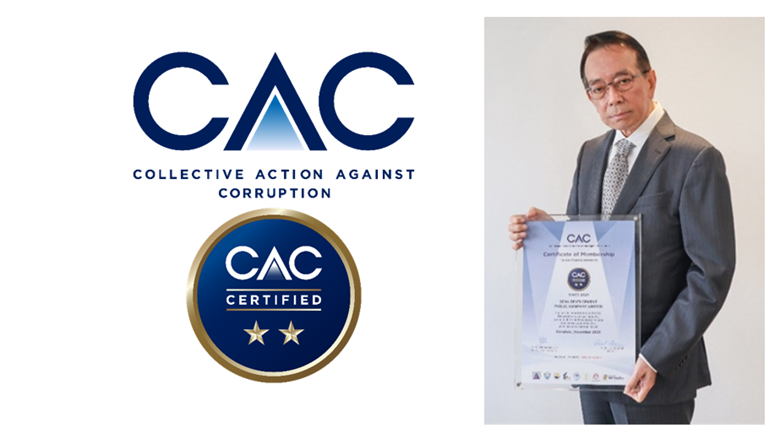
In November 2017, the Company received certification as a member of the Thai Private Sector Collective Action Against Corruption project.
For the year 2020, the Company applied for renewal of its certification as a member of the Thai Private Sector Collective Action Against Corruption (CAC). At the meeting of the Anti-Corruption Coalition Committee for Q3/2020, a resolution was passed to renew the certification of "Sena Development Public Company Limited" as a member of the Thai Private Sector Collective Action Against Corruption. This certification was valid for 3 years from the date of the resolution, expiring on December 31, 2023. The Certificate of Member was received in 2021.
For the year 2023, the Company applied for renewal of its certification as a member of the Thai Private Sector Collective Action Against Corruption (CAC). At the meeting of the Anti-Corruption Coalition Committee for Q3/2020, a resolution was passed to renew the certification of "Sena Development Public Company Limited" as a member of the Thai Private Sector Collective Action Against Corruption. This certification was valid for 3 years from the date of the resolution, expiring on December 31, 2023. The Company's membership has since been renewed until December 31, 2026, and the Certificate of Member was received in 2024, clearly demonstrating the Company's commitment to the anti-corruption initiative. For guidelines under the anti-corruption policy (further details can be found in the "Anti-Corruption Policy" on the Company's website www.sena.co.th under the topic "Anti-Corruption Policy").
The Company conducts risk assessments related to internal corruption, including preparing for self-assessment regarding anti-corruption measures. The Company believes that factors leading to corruption can be controlled through a robust internal control system, effective management of work processes, clear segregation of duties and organizational structure, and by educating personnel on anti-corruption. There are protection measures and mechanisms for whistleblowers, as well as processes for inspection, monitoring, and control to seriously signal the Company's vigilance against corruption issues. Transparent, reliable, and fair investigation processes are in place, along with clear and strict penalties for directors, executives, and employees at all levels who engage in corrupt practices.
The Company communicates its anti-corruption policies and measures, including relevant laws or regulations, to directors, executives, and employees. To foster understanding, instill awareness, and recognize the dangers of such actions, as well as to ensure all employees are aware of the impacts, damages, penalties, and complaint procedures. In the past year, all new employees underwent orientation on anti-corruption in accordance with the Company's anti-corruption policies and measures. This topic is a mandatory part of the orientation for all new employees, who must receive training before commencing work. 100% of the Company's employees have been trained and have signed acknowledging and agreeing to comply with the policy. To date, there have been no cases of corruption offenses.
Communication and Training
New Employees
All new employees receive a copy of the anti-corruption policy and are provided with training on the said policy during new employee orientation. on the annual commencement date 2025, with a total of 114 trainees.
Current Employees
All employees receive a copy of the anti-corruption policy to ensure they are aware of and understand the Company's anti-corruption policy. Furthermore, the Company will inform employees of any updated changes. Employees can access this information on the Company's website, the Company's intranet system, and through announcements on the Human Resources Department's online communication channels. Additionally, training is provided to all employees at least annually once, to ensure all employees are aware of and recognize the importance of the policy. For external parties and business associates, the Company will disseminate information through its website, annual reports, annual registration statements, as well as electronic channels or other channels deemed appropriate by the Company, to foster understanding and support anti-corruption efforts.
It is noted that, to date, the Company's Board of Directors and executives have not committed any offenses related to corruption or ethics.
Form of Anti-Corruption Operations
| Operation |
|---|
| The participation in anti-corruption projects |
| Communication and training for employees on anti-corruption policy and guidelines |
| Assessment and identification of corruption risk |
| Review of appropriateness in anti-corruption |
| The monitoring of the evaluation of compliance with the anti- corruption policy |
| Review of the completeness and adequacy of the process by the Audit Committee or auditor |
Number of Corruption Cases
| Metric | Current Year | Previous Year | Two Years Ago |
|---|---|---|---|
| Total number of cases or issues related to corruption (cases) | 0 | 0 | 0 |
Whistleblowing
Has the Company Implemented Whistleblowing Procedures?
Yes
Operations in the Past Year
Complaint Handling Policy
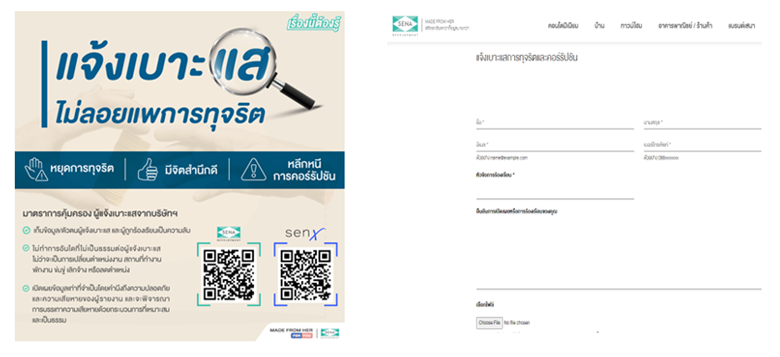
To enable both internal and external stakeholders to participate in the anti-corruption process, the Company has established a policy allowing all stakeholder groups to report / suggest / submit complaints or inquiries if they observe any actions suspected of violating or failing to comply with laws, regulations, rules, and business ethics. Tips and complaints can be submitted to the Chairman of the Company's Audit Committee or the Company's Human Resources Department. All complaints will be screened, investigated for facts, and reported to the Board of Directors for consideration and determination of appropriate measures. Complainants or whistleblowers will have their rights protected, whether they are employees of the Company or external individuals. The Company reserves the right not to disclose detailed information regarding investigations or disciplinary actions that may affect personal data and confidentiality, unless such disclosure is required by law and relevant regulatory bodies.
Channels for complaints and reporting corruption
-
Audit Committee Email: auditcom@sena.co.th
-
Mail to Company Secretary
-
Drop Box (located on P Floor, Head Office Building)
-
Call Center 1775
-
Report corruption via www.sena.co.th
-
QR code format
-
Sena Development Public Company Limited
P.O. Box 18, Muang Thai Phatra Complex Post Office, Bangkok 10324

In the year 2568 The Company has not received any tips or complaints related to corruption or violations of the Company's corporate governance policy.
Number of Whistleblowing Cases
| Metric | Current Year | Previous Year | Two Years Ago |
|---|---|---|---|
| Total number of cases or issues received through whistleblowing channels (cases) | 0 | 0 | 0 |
Selection of Directors & Chief Executives
Directors & Chief Executives — Introduction
The Board of Directors has considered and assigned the Nomination Committee to review the criteria and methods for selecting suitable candidates for the highest executive position. The Committee is to propose more than one suitable candidate, along with their justifications, for the Board of Directors' further consideration and appointment. The selection process involves carefully screening and identifying individuals who possess complete qualifications, suitability, knowledge, abilities, skills, and experience beneficial to the company's operations. These individuals must also have a thorough understanding of the company's business and be capable of managing operations to achieve the objectives and goals set by the Board of Directors.
Are Directors Selected Through the Nomination Committee?
Yes
Are Chief Executives Selected Through the Nomination Committee?
Yes
Number of Directors from Major Shareholders
4
Rights of Minority Shareholders on Director Appointment
The Board of Directors has established a policy that the Nomination and Remuneration Committee may consider selecting candidates to be nominated for appointment as directors from the list proposed by shareholders, for which the company has regularly provided equal opportunities and rights to all shareholders to make nominations.
Every year, in advance of the end of the accounting period, for a period of 3 months, through the company's website or through qualified individuals with knowledge and experience in the company's business, to ensure diversity in the Board of Directors' structure (Board Diversity), which comprises directors with knowledge, abilities, and experience in various fields such as expertise in real estate development business, accounting and finance expertise, legal expertise, knowledge and expertise in businesses related to real estate development, and management and administration expertise, among others, which are suitable for the company's operations and consistent with its plans and strategies.
In the year 2025, the company proceeded to announce information, nominating individuals for consideration and appointment as directors in advance of the meeting, in order to allow the Nomination Committee to screen and consider first, and then present to the Board of Directors for consideration to propose to the Annual General Meeting of Shareholders for approval. published on the company's website www.sena.co.th and announced online via the SET system to inform all shareholders, starting from September 30, 2024, with a period for receiving information from shareholders from October 1, 2024, to December 31, 2024, it appears that no shareholder nominated any individual for consideration as a director of the company.
Method of Director Appointment
| Method |
|---|
| Method whereby each director requires approval votes more than half of the votes of attending shareholders with voting rights |
Selection of Independent Directors
Criteria for Selecting Independent Directors
Criteria for the Selection of Independent Directors
Criteria for Selection of Independent Directors and Nomination of Directors and Senior Executives
Nomination Process
The Nomination and Remuneration Committee will consider nominating individuals for the position of company director based on recommendations from other directors within the company, nominations by shareholders for election as directors, nominations by external consultants, nominations from director databases of various agencies, or nominations through other processes deemed appropriate and suitable by the Nomination and Remuneration Committee.
Once the Nomination and Remuneration Committee has selected the list of individuals nominated as company directors or sub-committee members, the Nomination and Remuneration Committee shall consider and screen their qualifications as determined by the Board of Directors and according to the following selection criteria:
Consider the suitability of knowledge, experience, and specialized abilities that are beneficial to the company, with experience in the core business or industry in which the company operates, to ensure that the Board of Directors has the composition as specified. This is done by creating a Board Skills Matrix, which helps align the selection of directors with the company's business direction.
Consider diversity in terms of gender, age, race, nationality, expertise, skills, and experience (Board Skills Matrix/Board Diversities), as well as academic knowledge and abilities (Hard Skills and Soft Skills) and factors supporting sustainability, to obtain directors who can perform their duties effectively and support a complete and comprehensive composition of the entire Board of Directors, encompassing knowledge, abilities, experience, and diversity dimensions that contribute to maximum work efficiency.
Verify that the nominated individual possesses qualifications in accordance with laws and regulations of regulatory bodies, such as the Public Limited Company Act B.E. 2535 (1992) and the Securities and Exchange Act B.E. 2535 (1992).
Consider the time commitment of directors. If an existing director is to be re-appointed for another term, their performance during their previous term as director shall be considered. The number of listed companies each director holds positions in shall also be considered, to ensure suitability with the company's nature or business conditions, not exceeding 5 listed companies.
In the case of proposing the appointment of an independent director, the independence of the nominated individual shall be considered according to the criteria set by the SEC Office and the company's criteria, as well as the necessity of appointing additional independent directors if current independent directors are found to be unqualified. This is to ensure that the company's Board structure aligns with the policy set by the Board of Directors.
Consider the term of office for independent directors. If an existing independent director is to be re-appointed for another term,
shall have a continuous term of office from the date of initial appointment as an independent director not exceeding 9 years, without conditions.
Director Qualifications
possesses correct qualifications and is not subject to any prohibited characteristics under the Public Limited Company Act, Securities and Exchange Act.
company regulations, relevant regulatory bodies, and the company's good corporate governance. In the case of selecting a person to serve as a nomination committee member, such person must meet the qualifications of an independent director as defined by the company. For audit committee members, additional qualifications as prescribed by law must be met.is a qualified person with diverse knowledge, abilities, skills, experience, and expertise beneficial to the company's operations.
is independent, performs duties as a director with due care, is honest, has good physical and mental health, and can fully dedicate themselves to working with the company.
has a good work history, does not operate a business or is a partner in an ordinary partnership, or an unlimited liability partner in a limited partnership, or a director of another private or public company that operates a similar business and competes with the company's business.
Duties and Responsibilities of Independent Directors
Sena Development Public Company Limited has defined independent directors more strictly than the minimum requirements of the Securities and Exchange Commission (SEC) Office and the Stock Exchange of Thailand, as per the Capital Market Supervisory Board's announcement. The company has 6 independent directors, accounting for 54.54% of the company's directors, with details as follows:
Independent Director means a person who possesses full qualifications and independence as defined by the Board of Directors in the company's good corporate governance policy and in accordance with the criteria of the Capital Market Supervisory Board, namely:
holds no more than 1% of the total voting shares of the company, its parent company, subsidiaries, associated companies, or any juristic person that may have a conflict of interest. This includes the shareholding of persons related to the independent director.
is not or has not been an executive director, employee, staff, consultant receiving a regular salary, or a person with control over the company, its parent company, subsidiaries, associated companies, fellow subsidiaries, or any juristic person that may have a conflict of interest, unless such characteristics have ceased for at least two years prior to the appointment.
is not a person related by blood or legal registration as a parent, spouse, sibling, or child, including the spouse of a child of an executive, major shareholder, controlling person, or a person to be nominated as an executive or controlling person of the company or its subsidiary.
has no or has never had a business relationship, such as normal commercial transactions for business operations, leasing or letting of real estate, transactions related to assets or services, or providing or receiving financial assistance, including other similar circumstances with the company, its parent company, subsidiaries, associated companies, or any juristic person that may have a conflict of interest in a manner that could impede independent judgment of their own, and has never been a major shareholder, a director who is not an independent director, or an executive of a person with a business relationship with the company parent company, subsidiaries, associated companies, or any juristic person that may have a conflict of interest, unless such characteristics have ceased for at least 2 years prior to the appointment.
is not or has not been an auditor of the company, its parent company, subsidiaries, associated companies, or any juristic person that may have a conflict of interest, and is not a major shareholder, a director who is not an independent director, an executive, or a managing partner of an audit firm to which an auditor of the company, its parent company, subsidiaries, associated companies, or any juristic person that may have a conflict of interest belongs, unless such characteristics have ceased for at least 2 years prior to the appointment.
is not or has not been any professional service provider, including a legal advisor or financial advisor, who has received service fees exceeding 2 million baht per year from the company, its parent company, subsidiaries, associated companies, or any juristic person that may have a conflict of interest. In the case where the professional service provider is a juristic person, this includes being a major shareholder, a director who is not an independent director, an executive, or a managing partner of that professional service provider, unless such characteristics have ceased for at least 2 years prior to the appointment.
is not a director appointed to represent the company's directors, major shareholders, or shareholders related to the company's major shareholders.
is not a director assigned by the Board of Directors to make decisions on the operations of the company, its parent company, subsidiaries, associated companies, fellow subsidiaries, or any juristic person that may have a conflict of interest.
In cases where an independent director holds positions as an independent director in a parent company, subsidiaries, and fellow subsidiaries, the company must disclose information regarding such positions and the total remuneration received by that independent director in Form 56-1 One Report.
The continuous term of office for independent directors shall not exceed 9 years, without conditions, effective from January 1, 2019, onwards.
has no other characteristics that would prevent them from providing independent opinions on the company's operations.
Term of Office for Independent Directors
In 2018, The Board of Directors has reviewed the term of office for independent directors and resolved to set the continuous term of office for independent directors not exceeding 9 years, without conditions, effective from
January 1. 2019 onwards.
Did Any Independent Director Have a Business or Professional Relationship?
No
Director Development
Director Development — Introduction
The company has a policy to promote continuous and sufficient development of knowledge and capabilities among its directors by supporting them to attend training courses or seminars that enhance their operational knowledge, such as training organized by the Thai Institute of Directors Association (IOD). The company also provides an orientation for newly appointed directors to inform them of the company's business policies, as well as the scope of duties and responsibilities of the Board of Directors and its sub-committees. Additionally, various relevant information is provided, such as the Annual Registration Statement / Annual Report (Form 56-1 One Report), Corporate Governance Policy and Code of Conduct, and the Company's Articles of Association. Furthermore, the company has prepared a manual for directors, which compiles useful information for serving as a director of a listed company, including the Public Limited Company Act B.E. 2535 (1992), the Securities and Exchange Act (No. ) B.E. 2551 (2008), Principles of Good Corporate Governance for Listed Companies, and the Handbook for Directors of Listed Companies, among others.
Qualifications for Director Selection
| Qualification | Skill & Expertise |
|---|---|
| Possesses integrated skills and expertise, with knowledge in real estate development business from strategic to operational levels, combined with business administration knowledge focused on systematic growth. As a director, possesses expertise in setting direction and organizational management to enhance competitiveness, while emphasizing governance through stringent risk management to protect the interests of stakeholders. Furthermore, is a leader in driving the organization towards long-term success through sustainability principles (ESG) to create a tangible balance between business profitability and contributions to society and the environment. | 130 · Description: Property Development · 147 · Description: Sustainability · 158 · Description: Corporate Management · 165 · Description: Risk Management · 1683 · Description: Business Administration |
Evaluation of Board & Subcommittee Performance
Criteria for Evaluating Board Performance
The Company has stipulated in its Good Corporate Governance Policy that the Board of Directors shall conduct a self-assessment of its performance at least once a year, every year, using a Board Self-Assessment form. This assessment form is consistent with the updated guidelines of the Stock Exchange of Thailand, designed to provide the Board with a framework for reviewing its performance of duties and collectively considering achievements, problems, and obstacles encountered during the past year. It also aims to improve and develop the Board's performance in line with the established policies. The Company Secretary will distribute the performance assessment forms to all members of the Board of Directors for their annual performance evaluation, which comprises two types of assessment forms: a collective assessment form and an individual assessment form. After each director completes their assessment, the forms will be returned to the Company Secretary to compile the assessment scores of each director, summarize the analysis of the Board's performance assessment for the year, and report the results to the Board of Directors for consideration, in order to achieve the aforementioned objectives.
In the year 2025 The Board of Directors has resolved to approve the use of two types of performance assessment forms in accordance with the guidelines of the Stock Exchange of Thailand: a collective assessment form and an individual assessment form. The criteria for evaluating the Board's performance scores are divided into 5 levels, as follows:
Score Level % | Level |
85-100 | Excellent |
75-84 | Good |
65-74 | Fairly Good |
50-64 | Fair |
Below 50 | Needs Improvement |
Evaluation of Board Performance in the Past Year
Evaluation of the performance of the Board of Directors and sub-committees, criteria for evaluating the performance scores of the Board of Directors divided into 5 levels: Excellent, Good, Fairly Good, Passable, and Needs Improvement, with the annual evaluation results 2025 achieved an excellent score
Evaluation Results
| Evaluated Body | Group — Carried Out? | Group — Grade / Average Score | Group — Grade / Full Score | Individual (Self-Assessment) — Carried Out? | Individual (Self-Assessment) — Grade / Average Score | Individual (Self-Assessment) — Grade / Full Score | Cross (Assessing Other Directors) — Carried Out? |
|---|---|---|---|---|---|---|---|
| Board Of Director | Y | 93.33 | Excellent | Y | 86.73 | Excellent | N |
| Audit Committee | Y | 92.81 | Excellent | Y | 86.73 | Excellent | N |
| Executive Committee | Y | 99.21 | Excellent | Y | 86.73 | Excellent | N |
| Other Subcommittee | Y | 91.67 | Excellent | Y | 86.73 | Excellent | N |
| Other Subcommittee | Y | 98.61 | Excellent | Y | 86.73 | Excellent | N |
| Other Subcommittee | Y | 88.54 | Excellent | Y | 86.73 | Excellent | N |
Subcommittees
Subcommittees
| Results of the Subcommittee's Duty Performance | Meetings — Introduction |
|---|---|
The Risk Management Committee is responsible for establishing the framework for the company's risk management operations, including defining policies, structure, roles, duties, and responsibilities of those involved in risk management activities, and overseeing risks that may directly or indirectly affect the company, as well as providing recommendations on approaches to. Managing risks appropriately and efficiently in line with business operations, strategic direction, and business plans, as well as continuously and effectively supporting and developing risk management at all levels throughout the organization. In 2025, the Risk Management Committee held a total of 4 meetings, with all incumbent directors attending in full. The purpose was to monitor and consider important matters assigned by the Board of Directors, summarized as follows:
The Risk Management Committee has fully performed its assigned duties with due care, prudence, full capability, and independence, and is committed to ensuring that the company's risk management governance is at an acceptable level to ensure adequate, appropriate, and comprehensive risk management for the company's business operations, thereby achieving the defined objectives and goals. | The Board of Directors of Sena Development Public Company Limited has recognized the utmost importance of Risk Management and systematic and effective risk control amidst the company's continuous changes and expansion. This is to enable the company to achieve its established business objectives, build confidence, and ensure credibility for shareholders and stakeholders, appropriately in the company's business operations. Therefore, the Board of Directors has appointed a Risk Management Committee, comprising 8 members who possess knowledge, capabilities, experience, and a thorough understanding of business operations. |
In the year 2025, the Nomination and Remuneration Committee held a total of 2 meetings, with all incumbent directors attending to monitor and consider important matters assigned by the Board of Directors. The summary is as follows:
1.1 Consider the appointment of directors to replace those retiring by rotation. The Nomination and Remuneration Committee has conducted the process in accordance with the established procedures and criteria, to propose to the Board of Directors and the Annual General Meeting of Shareholders for approval. Interested directors shall not attend the meeting or vote on the matter. In 2025, the Board of Directors provided an opportunity for minority shareholders to participate in corporate governance and offer opinions on business operations, including proposing agenda items and nominating individuals to serve as directors in place of those whose terms were expiring, in advance for the year 2025, from October 1, 2024, to December 31, 2024, a period of 3 months, via the company's website. It was found that no shareholders nominated individuals for the director selection process at the Annual General Meeting of Shareholders for 2025. 1.2 Considering the appointment of sub-committee members whose terms have expired. The Nomination and Remuneration Committee considered the composition of the sub-committees, qualifications, knowledge, expertise, abilities, relevant skills, and suitability for performing the duties of various sub-committees, and presented them to the Board of Directors for consideration and appointment. 1.3 Reviewing the Succession Plan policy to comply with the principles of good corporate governance for listed companies in 2017 regarding the oversight of a succession plan to prepare for the succession of the Chief Executive Officer and Managing Director, and monitoring the implementation plan and Competency Gap Analysis assessment for successors. The performance results according to the succession plan are reported to the Board of Directors periodically, at least once a year.
In this regard, The Nomination and Remuneration Committee has fully performed its assigned duties with due diligence, prudence, and independence. It has provided straightforward and candid opinions, applying principles of equality, fairness, and transparency in accordance with good corporate governance practices, with the primary aim of serving the best interests of the company and all stakeholders. | The Nomination and Remuneration Committee of Sena Development Public Company Limited has performed its duties as assigned by the Board of Directors, in accordance with the roles and responsibilities stipulated in the Nomination and Remuneration Committee Charter. In its nomination considerations, the Committee has selected individuals with suitable qualifications consistent with the company's strategy, as well as relevant laws and criteria, and established processes for proposing appointments to positions as directors, senior executives, and persons with management authority in the company. Furthermore, it proposes policies and criteria for determining remuneration and other benefits for the Board of Directors and sub-committees. The Nomination and Remuneration Committee comprises at least 3 directors, with the majority of its members being independent directors and not serving as Chairman of the Board or executive directors. Currently, the Nomination and Remuneration Committee consists of 3 directors. |
In 2025, the Corporate Governance and Sustainability Committee held a total of 1 meeting, with all directors holding office at that time attending in full. The key matters tracked and considered, as assigned by the Board of Directors, can be summarized as follows:
With a strong commitment to operating under good corporate governance, social responsibility, and sustainable development, by continuously raising operational standards, the Corporate Governance Committee will perform its duties to its fullest capacity by overseeing, promoting, and supporting the company's strict adherence to good corporate governance policies and business ethics, alongside social responsibility, for the maximum benefit and equality of all stakeholders, and to lead the company towards stable and sustainable growth. | The Corporate Governance and Sustainability Committee of Sena Development Public Company Limited has performed its duties as assigned by the Board of Directors, under the roles and responsibilities stipulated in the Corporate Governance Committee Charter, in considering, establishing, reviewing, and improving policies, manuals, and guidelines for good corporate governance, business ethics, and social, community, and environmental responsibility (Corporate Social Responsibility : CSR) appropriate for the Company, to align with international standards of good corporate governance under the framework of relevant laws, criteria, and regulations, as well as overseeing and reviewing internal controls related to anti-corruption measures. The Corporate Governance and Sustainability Committee comprises 4 members. |
Meeting Attendance & Remuneration
Meeting Attendance — Introduction
The Company sets the criteria for Board of Directors meetings as follows:
The Board of Directors schedules meetings in advance each year, with at least 5 meetings annually, and additional special meetings as necessary and appropriate, with at least 5 business days' notice before the meeting. Generally, Board of Directors meetings are held every Thursday or Friday in the week of the 2nd or 3rd of the month, and may be changed or additional meetings scheduled as appropriate. Each director must attend at least 75% of the Board of Directors meetings held each year.unless there are reasonable and necessary grounds And for every meeting, at least half of the total number of directors must be present to constitute a quorum. For good corporate governance, the Company has a policy to set a minimum quorum for voting, requiring no less than 2 out of 3 of the total number of directors
Agendas are clearly defined in advance. The Chairman of the Board and the Chief Executive Officer should jointly consider selecting items for the Board meeting agenda, and the agenda must be clearly defined. The Company Secretary is responsible for ensuring that directors receive meeting documents sufficiently in advance of the meeting, at least 5 business days for studying and considering matters for opinion and voting.
The Board of Directors receives sufficient, complete, continuous, and timely information before every meeting. Directors can contact the Company Secretary directly and independently. The Company Secretary is responsible for advising the Board of Directors on matters related to compliance with laws and regulations.
The Chairman is responsible for allocating sufficient time for management to present information for discussion, and sufficient time for The Board of Directors, when discussing important issues, provides opportunities and encourages each director to express their opinions before concluding. obtained from the meeting
The Board of Directors has a policy to allow non-executive directors to meet among themselves as necessary to discuss various issues. regarding management matters of interest, without the presence of management, and the Chief Executive Officer should be informed of the meeting results.
The Board encourages the Chief Executive Officer to invite senior executives to attend Board meetings to provide additional detailed information as direct operational personnel.
When considering various agenda items, directors with a conflict of interest in the matter under consideration shall not have the right to vote and must not be present in the meeting during that agenda item. mentioned above
All meetings must have written minutes, and approved meeting reports must be stored by the Board of Directors, and be available for inspection by the Board and relevant parties.
Meetings among non-executive directors
without management attending the meeting to provide an opportunity for non-executive directors to discuss various issues arising in the company and recommendations for improving the company's operations, at least once a year. For the year 2025 Meetings 1 time in December 2025 to support the management's administration The company communicates the outcomes of post-meeting management processes, including suggestions and opinions from non-executive directors, to the management for further action.
Justification for Directors' Non-Attendance
Director No. 3. Ms. Kesara Thanyalakpark (Director) attended 4 meetings and attended online once, for a total of 5 times.
Director No. 9. Police General Achirawit Supanphesat (Director , Independent Director) was unable to attend 1 meeting due to other commitments.
Types of Remuneration of the Board of Directors
Remuneration for the Board of Directors The Board of Directors has established policies and criteria for the remuneration of the Board of Directors. and various sub-committees that is fair and reasonable with the Nomination and Remuneration Committee responsible for review by considering and screening the appropriateness of the remuneration that consistent with the assigned duties and responsibilities the performance of duties by the Board of Directors that benefits the company as well as compared with businesses in similar types and sizes as well as considering performance results business environment and overall economic conditions The directors' remuneration is regularly reviewed to align with the overall business landscape.
Policy and Criteria for Remuneration of the Company's Board of Directors
Remuneration for the Board of Directors, for which the Board of Directors has established policies and criteria for the remuneration of the Board of Directors and the committees.
various sub-committees that are fair and reasonable, with the Nomination and Remuneration Committee responsible for reviewing and screening the appropriateness of remuneration that aligns with the assigned duties and responsibilities, the performance of duties by the Board of Directors that benefits the company, as well as comparing with businesses of similar types and sizes, and considering performance, results, the business environment, and the overall economic conditions. The directors' remuneration is regularly reviewed to align with the overall business landscape.
The remuneration paid to the Board of Directors is in the form of meeting allowances, with no other benefits, in accordance with the resolution of the Annual General Meeting of Shareholders. 2025 with remuneration equal to the year 2023 2024 and 2025 in the past, details are as follows
Remuneration of the Company's Directors | Year 2023 (Baht/meeting) | Year 2024 (Baht/meeting) | Year 2025 (Baht/meeting) |
| 60,000 40,000 10,000 | 60,000 40,000 10,000 | 60 ,000 40 ,000 10 ,000 |
| 40,000 20,000 | 40,000 20,000 | 40 ,000 20 ,000 |
| 20,000 10,000 | 20,000 10,000 | 20 ,000 10 ,000 |
| 20,000 10,000 | 20,000 10,000 | 20 ,000 10 ,000 |
| 20,000 10,000 | 20,000 10,000 | 20 ,000 10 ,000 |
Remuneration of the Board — Introduction
In 2025, the Company held meetings of the Board of Directors and sub-committees as follows:
-
Board of Directors 5 times
-
Audit Committee 5 times
-
Executive Committee 27 times
-
Risk Management Committee 4 times
-
Nomination and Remuneration Committee 2 times
Remuneration or Benefits Payable to the Board
| Metric | Amount (Baht) |
|---|---|
| Remunerations or benefits pending payment to the board of directors over the past year (baht) | 0 |
Supervision of Subsidiaries & Associated Companies
Does the Company Have Subsidiaries or Associated Companies?
Yes
Is There a Mechanism for Overseeing Subsidiaries and Associated Companies?
Yes
Mechanism for Overseeing Management of Subsidiaries
The Company has the following management policies for its subsidiaries and associated companies:
Management Policy for Subsidiaries
The Company will establish business operational guidelines that it deems supportive of achieving its objectives and the Company's long-term goals to its subsidiaries through annual budget approvals and by appointing Company representatives at the executive director or senior management level to serve as directors in the subsidiaries. This is to define the subsidiaries' business strategies and monitor whether their operations align with the business framework set by the Company. Directors in subsidiaries who are Company representatives shall exercise their discretion in a manner that benefits the Company and the group as a whole. For matters of significance or those with implications for the subsidiary's business, directors in the subsidiary who are Company representatives shall report on operational progress or propose such matters for consideration and approval by the Executive Committee or the Board of Directors, as the case may be. Furthermore, management is responsible for reporting the financial status and operational performance of key subsidiaries by business line through financial reports to the Board of Directors on a quarterly basis.
Management Policy for Associated Companies
Once the Company has entered into a joint venture with another company, it will appoint representatives to serve as directors in those associated companies to monitor whether the associated companies' operations align with the Company's expectations.
Policy
The Company respects the rights and treats all stakeholders equally ( Equitable Treatment) and accountability for decisions and actions that can be explained and clarified. ( Accountability)
The Company ensures transparent and verifiable disclosure of information. ( Transparency)
The Company adheres to ethical principles and a code of conduct as the foundation for its business operations ( Code of Conduct and Code of Ethics)
The Company fosters growth for its subsidiaries and associated companies and enhances long-term shareholder value ( Creation of Long Term Value
while considering the rights of other stakeholders, maintaining a good balance between the differing interests of each stakeholder group and the company, with fairness to all parties.
In cases where the Company and its subsidiaries or associated companies may bid for competing projects, the Company's policy is not to compete in
core businesses with each other, and will operate to maximize benefits for the stakeholders of the Company, its subsidiaries, or associated companies.The Company is aware of its responsibilities and performs its duties to the best of its ability for its actions towards all stakeholders, especially shareholders. ( Responsibility)
Oversight Mechanisms
| Mechanism |
|---|
| Sending representatives to act as directors, executives or controlling persons in proportion to shareholdings |
| Defining the scope of powers, duties and responsibilities of directors and executives who represent the company in setting important policies |
| Disclosure of financial information and operating results |
| Transactions between the Company and related persons |
| Other important transactions |
| Acquisition or disposal of assets |
| Internal control system of the subsidiary operating the core business is appropriate and sufficient in the subsidiary operating the core business |
Agreements Between the Company and Shareholders in Managing Subsidiaries
Management Aspect
Consider sending qualified individuals to represent the company as directors and/or executives in subsidiaries and joint ventures, at least in proportion to the shareholding, to oversee and control business operations.
Report the aforementioned representative appointment along with the representative's qualifications to the Board of Directors for acknowledgment.
Oversee that the company's practices comply with approved authorities and operations, including the disclosure of information and any actions that adhere to the Securities and Exchange Act, as well as the regulations, announcements, orders, or requirements of the Stock Exchange of Thailand, including compliance with requirements regarding the disclosure of connected transactions and/or the acquisition or disposal of assets.
Summary reports of the performance of subsidiaries and joint ventures to the Board of Directors every quarter, and in cases of significant matters concerning
In carrying out the aforementioned operations, the company recognizes the importance of good corporate governance principles, which are key factors in strengthening the organization with an efficient system and is committed to conducting business in accordance with corporate governance guidelines to create a mechanism for controlling the company's operations to be transparent, fair, and to build confidence among all stakeholders.
In the past, the nomination and voting rights for appointing individuals as directors in subsidiaries and joint ventures were carried out by the management, since
Year 2018 onwards, in accordance with the Board of Directors' resolution to delegate authority to the Executive Committee to manage matters related to investment in establishing new subsidiaries and/or investments for joint venture projects, including the authority to undertake any necessary or related actions concerning the establishment of new companies and new company investments to support future real estate project development. However, if any investment exceeds the authority approved by the Board of Directors, it shall be submitted to the Board of Directors for further consideration and approval.
The company has established procedures requiring that such nominations and voting rights must be approved by the Executive Committee and reported to the Board of Directors. Individuals appointed as directors in subsidiaries or joint ventures are responsible for acting in the best interests of those subsidiaries or joint ventures. The company also stipulates that appointed individuals must obtain approval from the Executive Committee or the Board of Directors (as the case may be) before casting votes or exercising voting rights on significant matters. The appointment of directors to represent the company in such subsidiaries or joint ventures shall be in proportion to the company's shareholding.
Furthermore, in the case of a subsidiary, the company stipulates that individuals appointed by the company must ensure that the subsidiary has complete and accurate regulations regarding connected transactions, the acquisition or disposal of assets, or any other significant transactions of the said company, and applies the principles related to information disclosure and the aforementioned transactions in the same manner as the company's principles. This also includes overseeing the proper storage of data and accounting records of the subsidiary to enable the company to audit and compile consolidated financial statements within the stipulated timeframe.
Board Duty Performance — Overview
Board Duty Performance — Overall Description
The company focuses on sustainable business operations by prioritizing socially and environmentally responsible operations and in accordance with good corporate governance guidelines. The Board of Directors has established policies and practices for good corporate governance, anti-corruption within the organization, along with a business code of conduct, in compliance with the regulations of the Stock Exchange of Thailand and the Securities and Exchange Commission, as well as relevant regulatory bodies or good corporate governance guidelines, including sustainable business operation plans covering economic, social, and environmental aspects, to ensure the company to be an organization that conducts business responsibly, transparently and fairly, towards sustainable growth and development.
Under the company's operations, the Board of Directors has assessed the adequacy and sufficiency of internal control systems, covering organizational risk management and corruption risk assessment, to enhance employees' knowledge and understanding and to involve all employees in analyzing and assessing risks from both internal and external factors, to find effective management approaches to prevent and mitigate potential risks or impacts. Additionally, a manual of internal risk management guidelines has been prepared. Furthermore, the company emphasizes the prevention of corruption by establishing a written anti-corruption policy and actively promoting adherence to this policy.
Audit Committee Duty Performance
Results of the Audit Committee's Duty Performance in the Past Year
The Audit Committee met with management and the certified public accountants to consider and review financial transaction data and discuss Guidelines on matters that may change according to financial reporting standards, including meeting with the internal audit department to acknowledge the internal control system review report, independently exchanging opinions and suggestions, and reporting the meeting results to the Board of Directors for acknowledgment. A summary of key duties performed is as follows:
Reviewing financial reports. The Audit Committee reviewed and considered the quarterly financial reports and the annual financial statements for 2025, which had been reviewed and audited by the auditors. The auditors expressed an unqualified review result/opinion on these financial statements. The Audit Committee invited management and the auditors to attend all meetings where financial statements were considered. Questions were posed to the auditors regarding the accuracy and completeness of the financial statements, the appropriateness of accounting methods, adjustments of material items affecting the financial statements, the scope of the audit, and the adequacy of accurate and appropriate information disclosure. Furthermore, a report was submitted to the Board of Directors for consideration and approval of the said financial statements. Furthermore, the Audit Committee met with the auditors without the presence of management to independently discuss key issues in financial statement preparation and the disclosure of information beneficial to financial statement users.
Reviewing connected transactions or transactions that may have conflicts of interest. The Audit Committee reviewed connected transactions or transactions that may have conflicts of interest between the company and related entities, in accordance with the announcements of the Securities and Exchange Commission and the Stock Exchange of Thailand, to ensure that such transactions are conducted under general commercial terms and are reasonable, adhering to principles of accuracy, prudence, and transparency, and considering the benefits of the company and its stakeholders.
Reviewing the effectiveness of the internal control system. The Audit Committee reviewed operations to ensure compliance with the Securities and Exchange Act, regulations of the Securities and Exchange Commission, and provisions regulations of the Stock Exchange of Thailand, as well as compliance with other laws related to the company's business operations, including the adequacy of the internal control system by considering the audit plan and acknowledging audit reports from internal auditors, to ensure sufficient management to prevent or reduce errors, risks, or fraud. Audit Committee
It is of the opinion that the company's internal control system is appropriate and sufficient for business operations, and no material deficiencies were found.Reviewing good corporate governance. The Audit Committee reviewed the appropriateness of the corporate governance policy, considered and revised the Audit Committee Charter and the Internal Audit Department Charter, to ensure that the company has appropriate and effective corporate governance processes that build confidence among stakeholders and comply with good corporate governance principles.
Reviewing and overseeing anti-corruption policy. The Audit Committee reviewed the appropriateness of the anti-corruption policy and manual, compliance with self-assessment forms related to anti-corruption measures, as well as reviewing compliance with the anti-corruption policy and measures.
Oversight of internal audit work. The Audit Committee oversaw internal audit work by considering internal audit reports, which were reported by internal auditors at quarterly Audit Committee meetings. Discussions were held and/or recommendations were provided on various issues, including monitoring the progress of corrective actions for identified issues, to ensure that management prioritizes the management of identified risk issues and implements timely corrective actions. Furthermore, the annual internal audit plan and budget to support the implementation of the plan were considered and approved.
Considering the appointment of auditors for the year 2026. The Audit Committee considered and selected, then proposed the appointment of auditors, based on the qualifications of the auditors and their past performance, including considering the auditors' remuneration, and resolved to approve the auditors from Krin Audit Co., Ltd. as the auditors for the company and its subsidiaries for the year 2026. This will then be presented to the Board of Directors for consideration and further submitted for approval at the Annual General Meeting of Shareholders for 2026.
Monitor the utilization of raised funds to align with the disclosed objectives. The Audit Committee reviewed details related to the utilization of raised funds, including implementing mechanisms to oversee and accurately monitor the utilization of raised funds and appropriate and in line with the disclosed objectives.
In summary, the Audit Committee performed its duties and responsibilities as assigned and stipulated in the Committee Charter. Reviewed, utilizing knowledge, capabilities, experience, due diligence, and sufficient independence in performing duties to provide opinions and various recommendations. Throughout this period, excellent cooperation was received from the Board of Directors, management, and all relevant parties, and no practices were found that were not in compliance with the provisions of the Securities and Exchange Act and the regulations of the Stock Exchange of Thailand to enable the company to achieve its quality objectives under good corporate governance and for the utmost benefit of all stakeholders.
Executive Committee Duty Performance
Results of the Executive Committee's Duty Performance in the Past Year
In 2025, the Executive Committee held a total of 27 meetings. All directors holding office at that time attended the meetings in full to monitor and consider important matters assigned by the Board of Directors.
The Executive Committee has performed its duties in accordance with the scope, authority, responsibilities, and duties stipulated in the Executive Committee Charter, focusing on setting the company's strategies, business plans, and annual budgets, as well as overseeing and monitoring operational performance to efficiently meet established targets. Over the past year, the Executive Committee has considered and screened investment projects, new project developments, and the management of the company's assets to align with the organization's growth direction. Furthermore, it has focused on internal controls, appropriate resource utilization, and emphasized sustainable business operations, including promoting the development of environmentally friendly residential projects, efficient energy use, innovation in living solutions, and creating value for all stakeholders, including customers, employees, partners, and society.
Overall, the Executive Committee has also monitored economic situations and environmental factors that may impact business operations, while establishing adaptation and operational guidelines in line with good corporate governance principles and the company's sustainable development approach.
Furthermore, the Executive Committee has regularly reported its operational performance to the Board of Directors and is of the opinion that the company's operations in accordance with the business plan, under the appropriately defined charter framework, and can stably and sustainably support the company's growth.